
RTK: less terminal noise for coding agents
My experience with RTK, a fast Rust CLI tool that shortens terminal output for LLMs and coding agents while keeping context cleaner.
Published · April 18, 2026
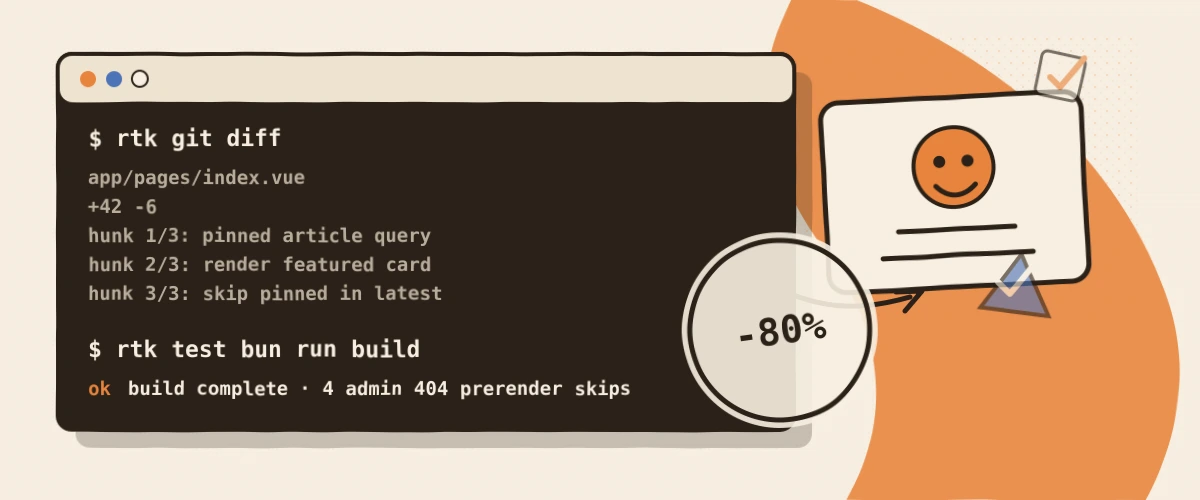
Coding agents are surprisingly good at working through code.
They are also surprisingly good at filling their context with terminal output nobody needed at that length.
A git status here.
A grep there.
A test run that prints 200 lines of success noise when only three error lines mattered.
And suddenly terminal noise fills the context that the problem actually needs.
That is why I like RTK.
It is not spectacular. It just makes a very boring thing smaller.
What RTK actually does
RTK stands for Rust Token Killer and lives here: github.com/rtk-ai/rtk.
The idea is simple: RTK sits in front of common terminal commands and gives the agent a condensed version instead of the full wall of text.
Status, relevant files, errors, diffs, summaries.
None of that is about hiding information. It cuts away what is only eating space in an agent context.
What changes in practice
The difference is not that my terminal suddenly becomes exciting.
Thankfully.
The difference is that an agent sees what is going on faster. rtk git status is not a small Git novel. rtk git diff points more directly at the relevant parts. rtk grep feels less like a raw wall of matches. And with tests, I usually do not care which 97 things passed. I care what broke.
That sounds small.
It is.
But those small things often decide whether an agent session stays clean or slowly drowns in text junk.
Why this fits agents especially well
I work a lot with coding agents. They are strong, but they eat context.
Raw terminal output is often absurdly wasteful there: 200 lines when only three matter.
RTK sits exactly at that point and turns "here is everything" into "here is what you probably need".
It has integrations and hooks for several agent setups, including Claude Code, Codex, Cursor, Windsurf, Pi and others.
You can also just call RTK directly in front of commands.
What it is not
RTK is not a substitute for understanding.
And it is not a magical "makes everything faster" layer.
If I need the complete output, I want the complete output. If a tool needs raw debugging, I skip RTK.
That matters to me: RTK should not decide what is true. It should only sort the first look.
Who it is worth it for
People who live in the terminal and work with LLMs or coding agents.
If you regularly throw logs, diffs, search results and test output into an agent context, RTK is one of those tools that disappears after setup.
Best compliment.
It is not a big productivity promise.
It is just less noise exactly where noise gets expensive.
And that is pretty good stuff.
✦RTK is beautifully unspectacular: less terminal noise, less token waste, faster orientation.
More good stuff
 Heißer Tipp
T3 Code: my Claude and Codex subscriptions in one app, without the nagging worry
My experience with T3 Code as a front end for Claude Code and Codex, using both subscriptions the way the providers intend while still switching models freely.
Pi stays my harness. But as soon as my Claude subscription has to be part of the deal, T3 Code is the front end that lets me stop thinking about account bans. Würd ich wieder kaufen
Backforce One Plus: the chair I only write about because something broke
My experience with the Backforce One Plus after 2.5 years: a good office chair, but the real story is the warranty claim and how fast support actually was.
Two years of just being a good chair. And when something did break, support was faster than any expectation. That is exactly why I would buy it again. Game Changer
SureFeed Microchip Pet Feeder: how three cats finally eat their own food
My experience with the SureFeed Microchip Pet Feeder in a house with three cats, two prescription diets and one cat that eats three times as fast as the others.
I no longer stand next to the bowls keeping track of who empties which one. Every cat gets her own food, including the slow one.